

After jumping on the Decolonise-Everything-You-Can-Think-Of trend, and the Museums Are Not Neutral Campaign, cultural institutions have gone a bit quiet on the neutrality tagline. And just as well, we all know it's near impossible for any space, especially one so loaded with coloniality, to be considered neutral. Just a few weeks ago, the V&A hosted a fundraiser for the Tory party, and with the government meddling in who sits on boards we seem to have moved miles away from any semblance of neutrality.
But museums often do claim to be spaces that are secular, which according to google dictionary, means that they are not connected with religious or spiritual matters. In practice though, it can mean many things; when spaces get it right, people of all faiths and none are welcomed, recognised, and celebrated. But when spaces get it wrong, which unfortunately is often the case, it could mean that people of a particular faith are favoured over others, or some groups are marginalised and demonised, reflecting what occurs in dominant media narratives and wider society.
And undoubtedly, whether people of faith are present or not, objects are. For example, British museums and libraries are filled with Qurans and manuscripts, and even minbars and mihrabs. Completely decontextualized, how are objects that would otherwise be part of a sacred and spiritual practice, be featured in the colonial showcase? Who sets the narrative, and who is it approved by? Are there sensitivity readers and copy editors who know about the objects, and would use equivalents of them in their own lives? Obviously not, and herein lies the problem. Not only have these objects been severed from their intention, but also their purpose and meaning. For instance, the Jameel Gallery at the V&A museum houses some of the most incredible objects from Muslim art and architecture over time, and is a must-,see on any visit. Whilst ceramic bowls and panels of tiles are not in and of themselves sacred objects, nor specifically used in any spiritual practice or rituals, the inscriptions and patterns on them tell us more about the people who made and used them, and tells us their stories. We can learn so much about not only how a faith was and is practised by parts of societies, but also the relationship between people and travel and trade, and colonial theft and pillage around the world. These factors, however, don't often feature on museum labels.
The same gallery, like in many museums in the UK, also displays Quran folios and manuscripts, but again without much context. We are given an introduction on the significance of the Quran, and the manuscripts, and also some information about where and when they are from, who they were commissioned by, and the technical aspects such as the calligraphic script and materials used. In some cases, we are even given the surah number, but that is where the information ends. There is no translation (or transliteration) of the text, no audio (the quran is there to be recited as well as read) nor any commentary or background of the verses, nor any information on how it ended up in a glass display cabinet in London. Some would say that this is too much to ask of a museum, that the text needs to remain short, concise, something someone can read in a minute or two. But what then of ‘community engagement’ and ‘visitor experience’? Or perhaps, the lack of background and context tells us more about the museum and the establishment’s image of itself than of the objects within it.
The same could be said for the architectural pieces that are in the gallery - a minbar from 15th century Egypt, ceramic panels from a tomb in Uzbekistan and a tiled chimneypiece from Turkey. And I'm sure that all of these pieces of internal architecture would be much more at home, well, in Cairo, Bukhara and Istranbul. Undoubtedly, whilst these objects tell us so many stories, they are incredible examples of beauty and technical excellence. They can be considered art. Which is a great excuse for the museum to keep hold of them, and dictate the narrative. But they are not solely art pieces. And in most cases of colonial loot, does the museum inform us about them, or do they tell us more about the museum's perception of itself, and protect the narrative of a version of British history.
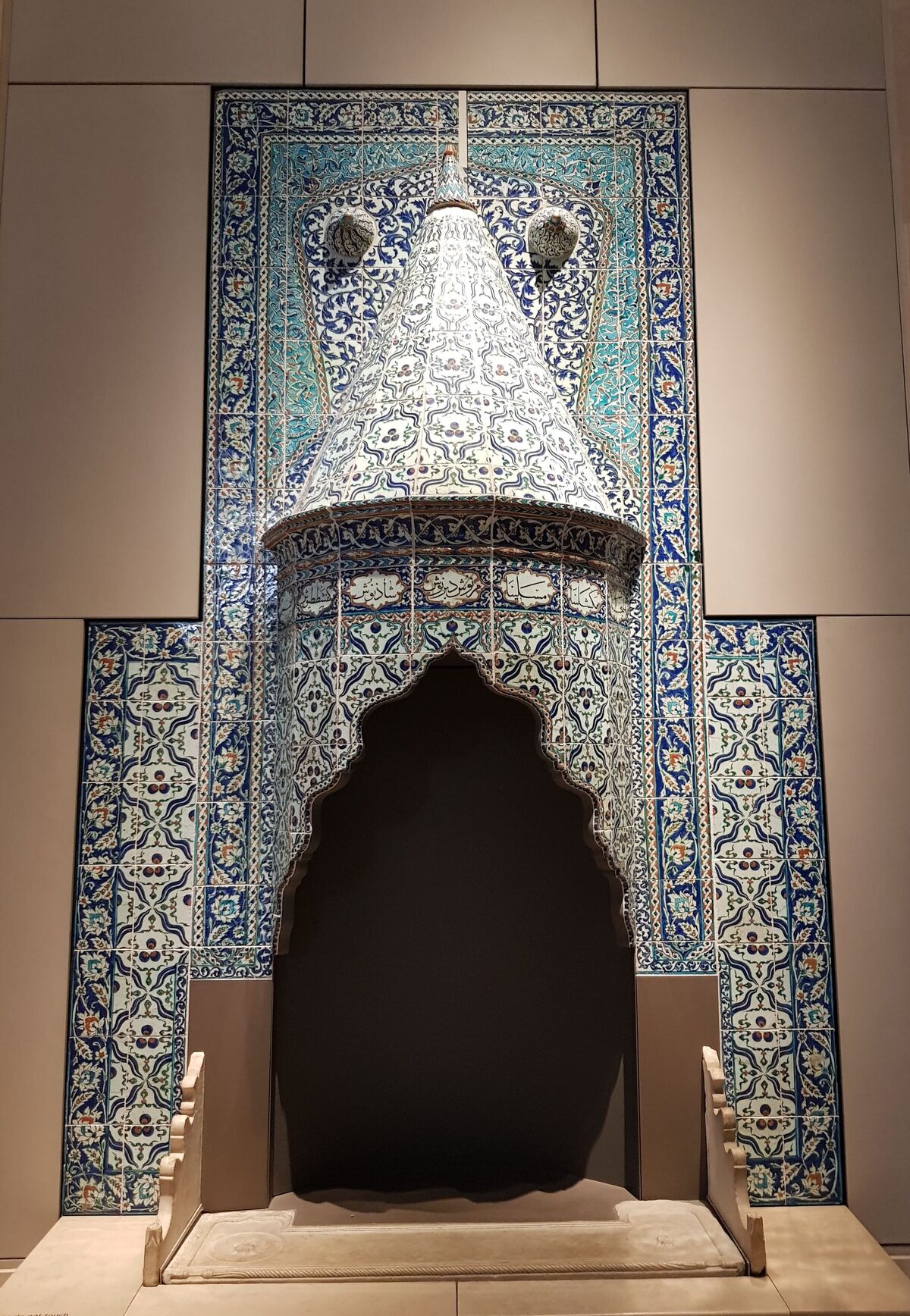
A 15th century mihrab from Egypt on display at the Jameel Gallery
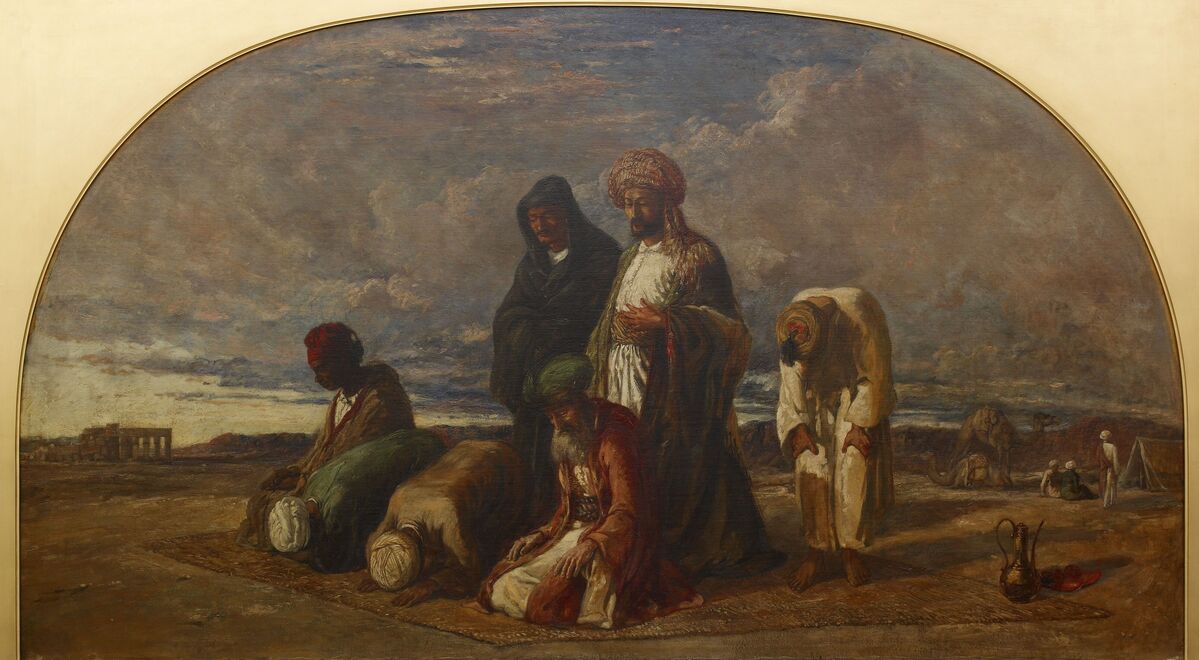
Birmingham Museum and Art Gallery, which also holds many objects in its collection from Muslim histories and regions, also took a different approach to displaying objects of a sacred nature. The faith gallery opened in 2016, and features objects that are relevant to all or most of the faiths practised in the city, involving local community and faith groups in discussions around some of the displays. One piece, which was previously on show in the gallery, is the 1840 oil painting, Prayers in the Desert, by Bristolian artist William James Muller. Whilst the image, a pastoral scene of men at different stages of their prayers, with animals and ruins in the background, may evoke feeling of being in nature and the importance of prayer to the viewer, it is interesting that the curator decided to include a piece by an orientalist painter, and especially one who accompanied the british government and archeologist Charles Fellows on an expedition to Lycia (Turkey) to remove the Xanthus Marbles for the British Museum. Instead, a piece on prayer by a local Muslim artist could have been included, making space for more varied voices and platforming someone from the local faith communities, which would have been much more sensitive and relevant to the museum’s apparent target audience. So does this then show us the museum’s attitude to the city’s communities, that an irrelevant orientalist narrative is more deserving of space than people who actually practise that faith? I haven't been able to visit the museum since the pandemic started, and can only hope that the painting has now been replaced by something else.
Museum collections and displays hold a huge number of objects relevant to faith practices, but how many members of the board, the staff beyond cleaning and security, and even visitors are from those same faith groups? Is it tokenistic for museums to host open iftar events during Ramadan, but refuse to provide dedicated prayer and quiet space throughout the year?
Within such a context, organisations like the MIAH Foundation can offer much needed awareness and understanding of the arts, culture and heritage of the islamic world. MIAH works from and within communities to better understand our contexts, and plans to raise funds to establish the UK’s first independent museum dedicated to the arts and heritage of Muslims. By standing independently, the organisation also aims to include varied voices, increase representation and engagement, but through thoughtful and meaningful provision that considers peoples’ faith, spirituality and cultural identities. There are a number of similar organisations and collectives doing the same for their faith and cultural communities, independent of long established institutions. Sharing know-how and resources, collaborating on important work and supporting each other to achieve short and long term goals is not only mutually beneficial, but also the only way that we will be able to establish ourselves and create spaces in the current landscape, and work towards longevity and legacy for future generations, giving our heritage, experiences and stories the importance that they deserve.
Header Image Details:
Prayers in the Desert, 1840-1849 | William James Muller d.1845
1885P2529 | Birmingham Museum & Art Gallery | Photo by Birmingham Museums Trust, licensed under CC0